


So often in life we set goals and treat them as finish lines. If I earn this much money. If I get this title. If I land this dream job. And yet, when we finally get there, it often feels… underwhelming.
That’s because the real change didn’t happen at the moment of achievement. It happened on the way there. The sacrifices. The resistance. The problems you had to solve. The moments where quitting would have been easier. That’s where the growth happened.
By the time you reach the goal, you are already a different person, which is why you immediately start reaching for the next one. That’s why goals shouldn’t be treated as endpoints. They’re better understood as mile markers on a much longer journey.
Even Scottie Scheffler, the number one golfer in the world, has spoken about the emptiness that can exist at the peak of the mountain he spent his entire life climbing. In a recent brutally honest, yet refreshing interview, he said:
It’s a modern King Solomon moment, the realization that fulfillment doesn’t come from the achievement itself, but from the struggle, discipline, and growth required to get there. The challenge, not the trophy, is what changes you.
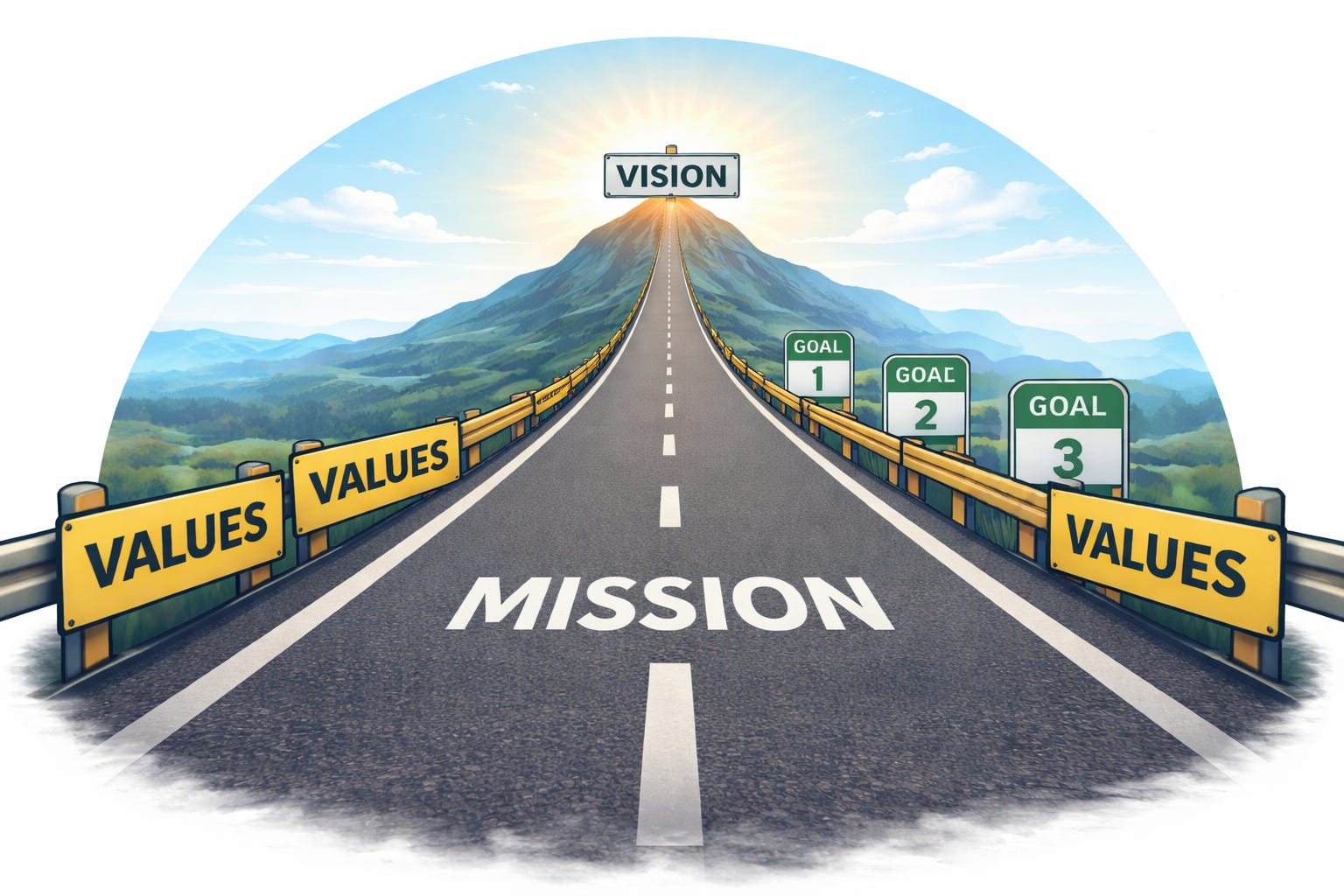
I’ve always pictured vision, mission, values, and goals using a road trip analogy.
Your vision is where you’re going. It’s the north star. You may never fully arrive, but you know the direction. And that’s the point. Once you believe you’ve “arrived,” growth stops. Stagnation sets in. To me, stagnation is death.
Your mission is the road you take to get there. It’s your purpose, your why. Like any road, it comes with detours, construction, and unexpected, and my times uncontrollable, obstacles. The route may change, but as long as you’re still moving toward your vision, the journey still matters.
Your values are the guardrails. They exist in the most dangerous parts of the road: tight curves, bad weather, low visibility. Ownership. Accountability. Resilience. Hard work. Values keep you on the road when conditions are bad and quitting would be easy.
And your goals? They’re the mile markers. They tell you you’re making progress. Without them, it’s easy to lose hope, or worse, to sit stalled on the side of the road for years without realizing it.
The analogy goes further.
The vehicle is your tasks and objectives. The gas pedal is your motivation, intrinsic or extrinsic. Your GPS is mentors and guides who help keep you oriented. Your dashboard and speedometer are your metrics and KPIs. Your headlights are clarity and communication. Your rearview mirror is reflection, useful, but dangerous if stared at too long (sorry metaphor overload).
You’ll pick up passengers along the way. That makes the journey better, or at least more enjoyable. You’ll break down sometimes. That’s when the tools in your trunk, your skills, matter. But skills are only built by doing. Watching a video isn’t the same as turning the wrench yourself.
That’s why direction matters. In Alice in Wonderland, Alice asks the Cheshire Cat which way she should go.
“That depends on where you want to get to,” he replies.
“I don’t really care,” she says.
“Then it doesn’t matter which way you go.”
Driving without a destination will get you somewhere, but there’s no guarantee it’s somewhere you actually want to be. We all drive different cars. We move at different speeds. We face different detours. Comparing yourself to someone else’s vehicle, pace, or destination is pointless. What matters is knowing you’re on your road, headed toward your vision.
That’s what makes the trip worth taking in the first place.
Check out the podcast I did talking about my journey in this week’s episode of Game Plan.
